
Calculate the cubic-meter volume of packed boxes
CBM means cubic meter, a unit of volume used to describe how much space cargo occupies. Measure the outside length, width and height of the fully packed box, then enter how many boxes share those dimensions. Choose centimeters, meters, millimeters or inches for each box type. All three dimensions within one type use that unit. If your shipment contains different sizes, add a separate type for each size. The result combines their volumes and shows total boxes, liters and approximate cubic feet. Inputs are processed in your browser, without being sent to a separate calculation server.
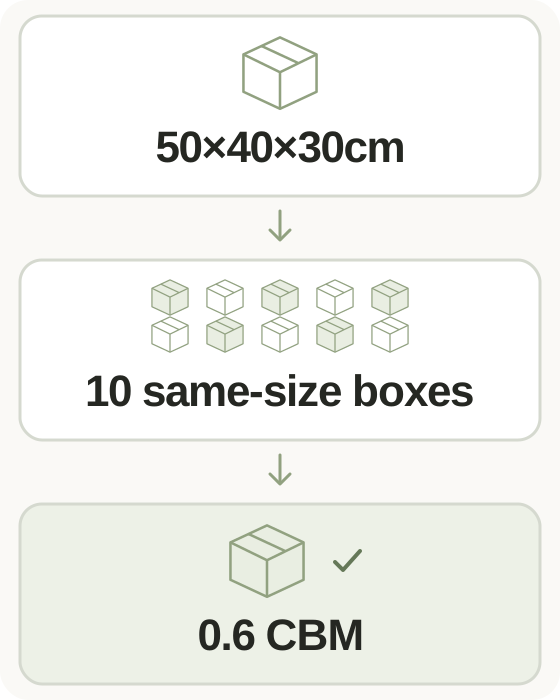
Step-by-step instructions and example screen
From input to result
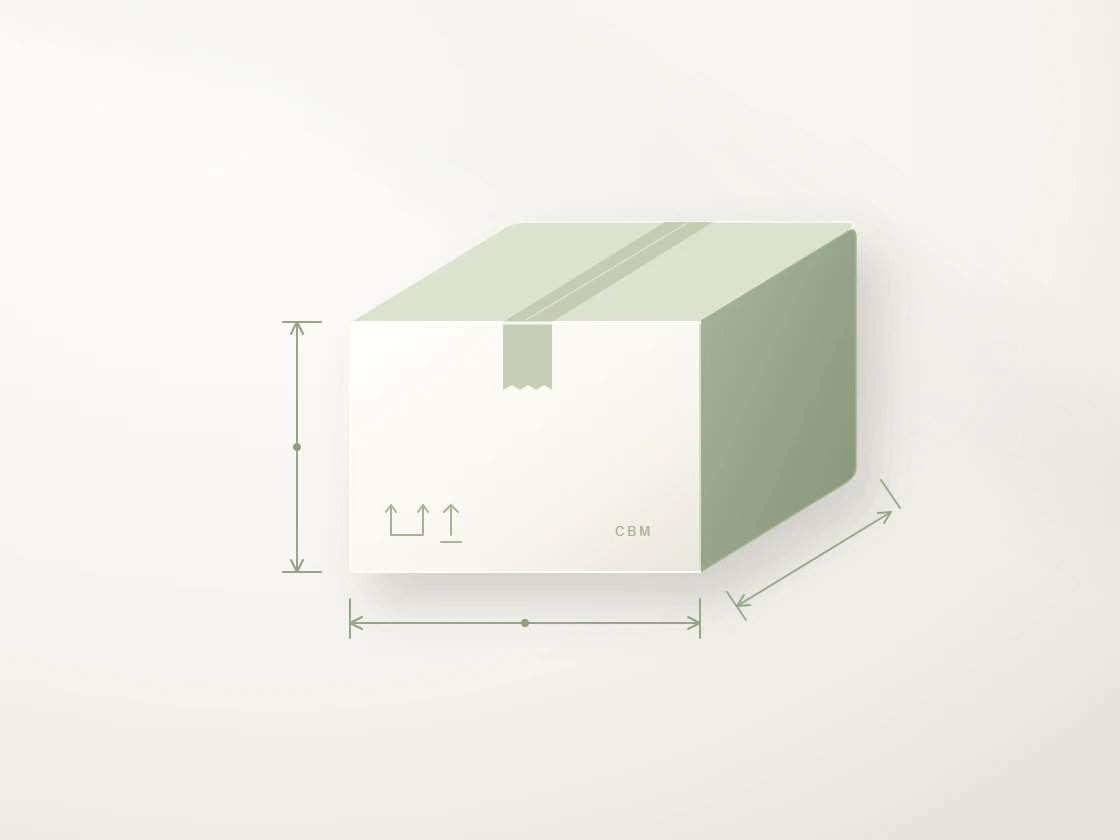
- Enter the outside length, width and height of the packed box, and choose its measurement unit.
- Enter the quantity of that size. Add another box type if the sizes or units differ.
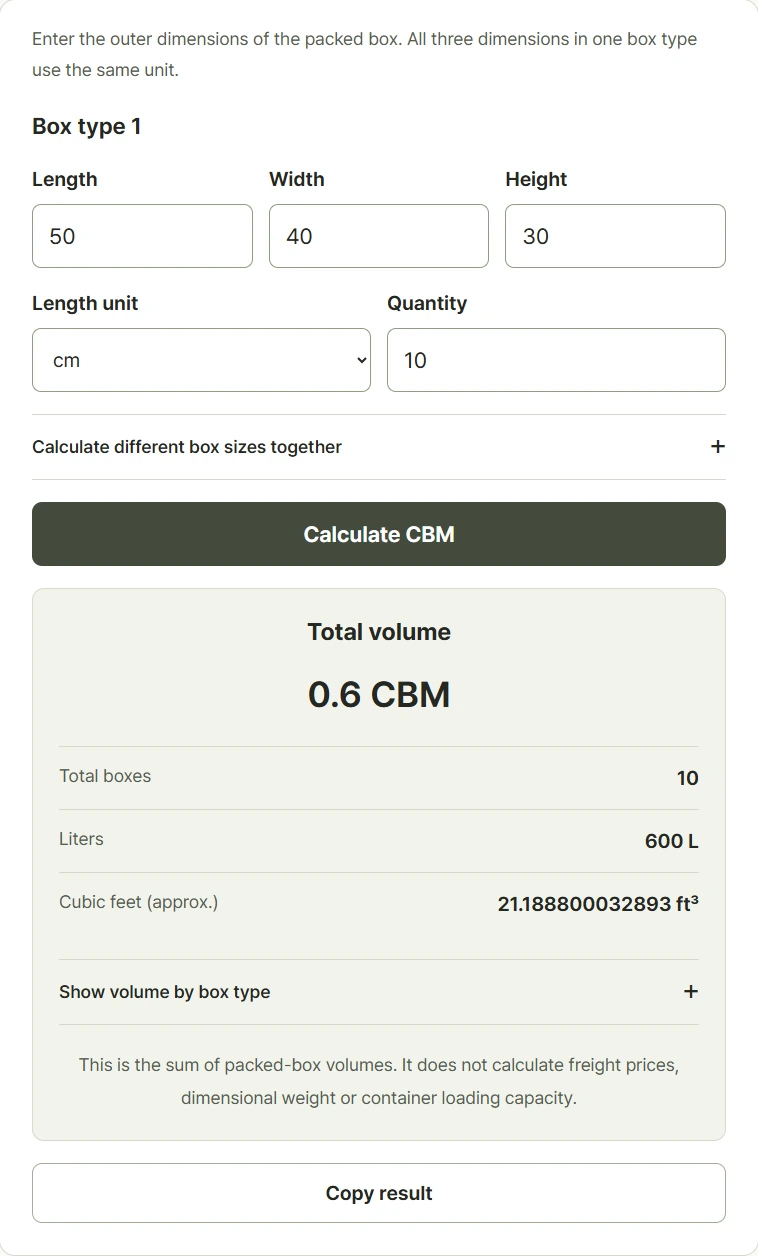
- Select Calculate CBM, review the total and box-type breakdown, and copy the result if needed.
When to use this tool
Total identical cartons
A 50 × 40 × 30 cm carton has a volume of 0.06 CBM. Set the quantity to ten to get 0.6 CBM; multiply by quantity once, after finding one box's volume.
Combine a mixed shipment
Add ten cartons of 50 × 40 × 30 cm and one crate of 1 × 1 × 1 m as two types. Together they total 1.6 CBM, even though their input units differ.
Compare fully packed sizes
A product's own dimensions can differ from its final box size. Measure after packing, including protective materials and protruding outer edges.
Examples and calculation method
Worked examples
| Box dimensions | Quantity | Total volume |
|---|---|---|
| 50 × 40 × 30 cm | 10 boxes | 0.6 CBM / 600 L |
| 1 × 1 × 1 m | 1 box | 1 CBM / 1,000 L |
| 500 × 400 × 300 mm | 2 boxes | 0.12 CBM / 120 L |
CBM formula and unit conversion
Multiply length, width and height in meters, then multiply once by quantity. With centimeter measurements, divide the product by 1,000,000; with millimeters, divide by 1,000,000,000. For inches, convert each dimension using 1 inch = 0.0254 meters first. The calculator totals each box type separately, preserving the supported input precision for CBM and liters. One cubic meter is 1,000 liters. Cubic feet use 1 foot = 0.3048 meters and are rounded to twelve decimal places.
Understanding your result
- CBM measures volume; kilograms measure mass. Do not treat the CBM result as a weight or a freight quote.
- If you measure a packed pallet as one outer rectangle, avoid also adding its individual cartons a second time.
- The sum does not account for box orientation, stackability, gaps, container door clearance or an actual loading plan.
Frequently asked questions
Frequently asked questions
How do I calculate CBM from centimeters?
Multiply length × width × height × quantity, then divide by 1,000,000. Ten boxes measuring 50 × 40 × 30 cm total 0.6 CBM.
Should I measure inside or outside the box?
Use the outside dimensions after closing the packed box. Include bulges and protruding packaging when measuring the maximum dimensions.
Can I combine different box sizes?
Yes. Add up to twenty box types, each with its own dimensions, unit and whole-number quantity. The calculator adds the volume of every type.
Does CBM tell me the freight price or how much fits in a container?
This tool adds rectangular packed-box volumes. It does not calculate freight prices, dimensional weight, billing minimums, pallet gaps or actual container loading arrangements.
What input precision is supported?
Each dimension must be positive, at most 1,000,000 in the selected unit, and have up to three decimal places. Quantities are whole numbers from 1 to 1,000,000 per type. CBM and liters preserve that input precision; cubic feet are rounded.