
Convert common measurements without mixing unit categories
Choose length, mass, or temperature, then enter a value and select its starting and destination units. Length supports meters, centimeters, millimeters, kilometers, inches, feet, yards, and miles. Mass supports kilograms, grams, pounds, and ounces. Temperature supports Celsius, Fahrenheit, and Kelvin. Keep the source unit attached to your original measurement so you do not accidentally convert from the wrong scale. A value of one hundred centimeters is one meter, while one hundred Fahrenheit is a different temperature from one hundred Celsius. Use the conversion result with a sensible number of decimal places for the precision of the measurement you started with.
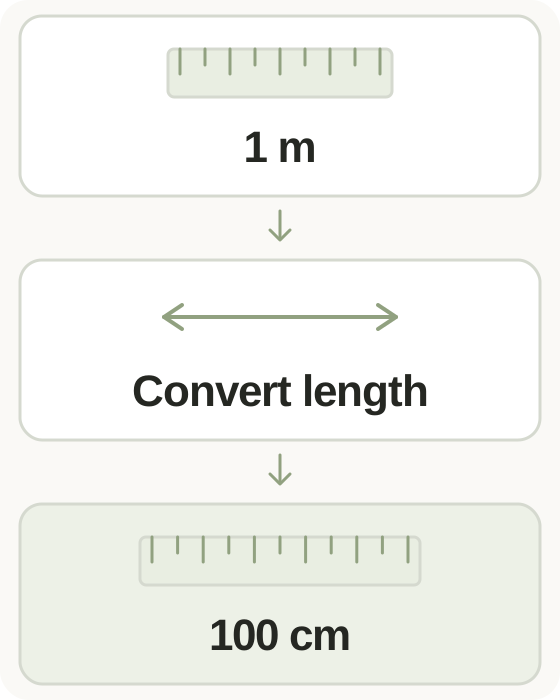
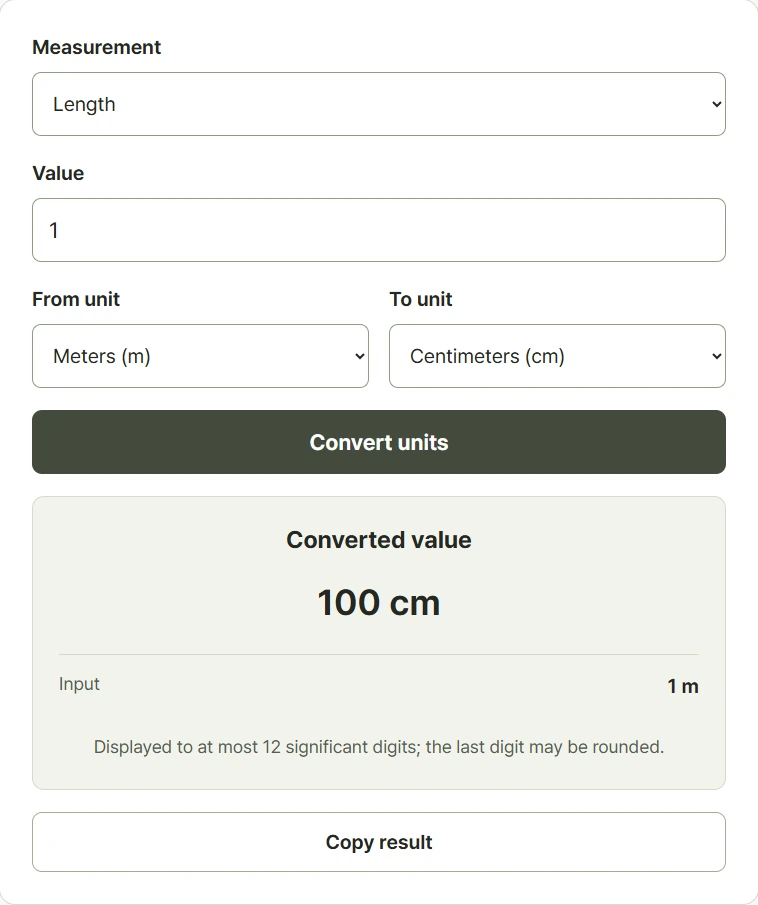
Step-by-step instructions and example screen
From input to result
- Choose the measurement category: length, mass, or temperature.
- Enter the value and select the source and destination units.
- Convert and read the result together with its unit.
When to use this tool
Compare dimensions
Convert an item measured in inches to centimeters before comparing it with a space measured using a metric ruler.
Read a mass measurement
Convert pounds to kilograms or ounces to grams when checking a measurement expressed in an unfamiliar mass unit.
Understand a temperature
Convert a Fahrenheit weather reading into Celsius or compare a Celsius reading with Kelvin using the correct scale and offset.
Examples and calculation method
Worked examples
| Measurement | Conversion | Result |
|---|---|---|
| Length | 100 cm to m | 1 m |
| Mass | 1 lb to kg | 0.45359237 kg |
| Temperature | 0 degrees Celsius to Fahrenheit | 32 degrees Fahrenheit |
Scale factors for length and mass, offsets for temperature
Length and mass values are converted through a common base unit using their scale factors. One inch equals 0.0254 meters, and one pound equals 0.45359237 kilograms. Temperature needs offsets as well as scaling: Fahrenheit equals Celsius times nine divided by five, plus thirty-two; Kelvin equals Celsius plus 273.15. Inputs must be finite and within negative to positive 1,000,000,000,000. Temperature inputs cannot be below absolute zero. Results display up to twelve significant digits, so consider rounding when transferring a result elsewhere.
Understanding your result
- Choose the original unit carefully; the same numeric value can represent very different measurements in different units.
- Temperature must be at least absolute zero: 0 K, -273.15 degrees Celsius, or -459.67 degrees Fahrenheit.
- Keep the destination unit with the copied number and round only as much as your use requires.
Frequently asked questions
Frequently asked questions
Which units can I convert?
Length: m, cm, mm, km, in, ft, yd, mi. Mass: kg, g, lb, oz. Temperature: Celsius, Fahrenheit, Kelvin.
Can I convert mass directly into length?
No. They measure different quantities. Choose source and destination units within the same supported measurement category.
Does doubling Celsius double Fahrenheit?
No. Celsius and Fahrenheit have different zero points. Conversion requires both a scale factor and an offset, so doubling a reading is not a direct conversion rule.
Why does a converted number have many decimals?
A simple value in one unit need not be a short decimal in another. Round according to your original measurement's precision and intended use.