
Roll custom dice for a game or probability exercise
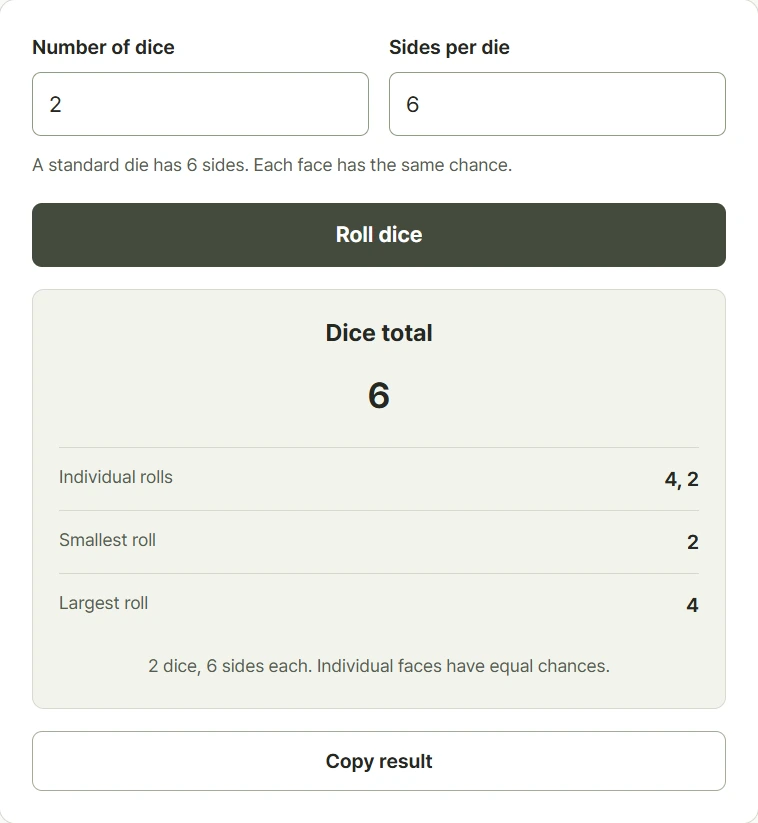
Choose how many dice to roll and how many sides each die has, then roll them together. The tool supports one to twenty dice and two to one hundred sides per die. Every die returns a whole number from one through the selected side count. Read the individual values as well as the total, especially when a game uses matching faces or specific outcomes instead of only the sum. Repeated values are allowed because each die is a separate draw. The same set of values can also appear on another roll. Set the rules before rolling so the group knows which outcomes count.
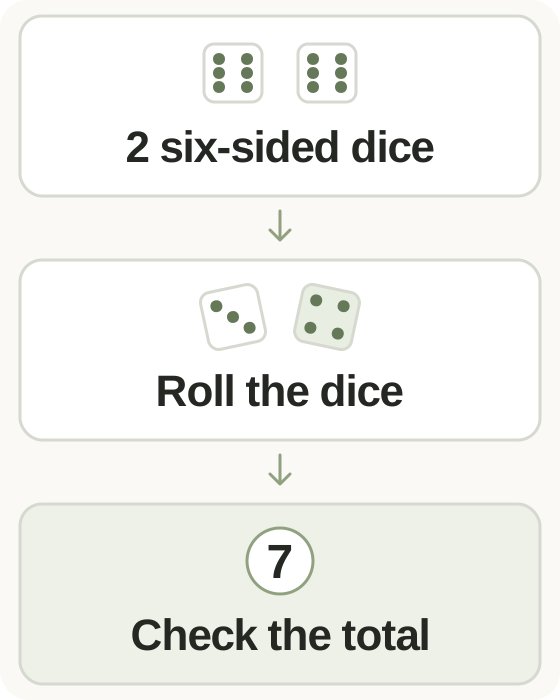
Step-by-step instructions and example screen
From input to result
- Choose 1 to 20 dice and 2 to 100 sides per die.
- Roll the dice using those settings.
- Read each die's value and the total, then roll again when needed.
When to use this tool
Replace a missing game die
Roll one six-sided die for a game that uses faces one through six, checking the displayed value before taking the next turn.
Compare sums in a lesson
Roll two six-sided dice repeatedly and record both faces and their sum to explore how several combinations produce the same total.
Use a custom side count
Choose a twenty-sided die for a rule that requires outcomes one through twenty, or another supported side count for your own activity.
Examples and calculation method
Worked examples
| Dice | Sides each | Possible total |
|---|---|---|
| 1 | 6 | 1 to 6 |
| 2 | 6 | 2 to 12 |
| 3 | 20 | 3 to 60 |
Independent die values and possible totals
Each die uses browser Web Crypto randomness to choose an integer from one through its side count. Every face has the same chance on an individual die, and values can repeat across dice. For n dice with s sides, the smallest total is n and the largest is n times s. Totals are not equally likely with multiple dice: different combinations of faces can produce the same sum.
Understanding your result
- The dice count must be from one to twenty, and each die's side count must be from two to one hundred.
- Repeated faces are expected; this tool rolls independently rather than drawing unique values.
- Use the individual values when a game checks matching faces; the total alone does not preserve every detail of a roll.
Frequently asked questions
Frequently asked questions
Can several dice show the same number?
Yes. Each die is a separate draw from the same face range, so repeated values are normal and are not removed.
Are all totals equally likely?
No. Individual faces have equal chances, but several face combinations can lead to the same total. With two six-sided dice, seven has more combinations than two.
Can I use a die with twenty sides?
Yes. Choose any whole-number side count from two to one hundred and a dice count from one to twenty.
Does a new roll depend on the previous one?
No. The current settings define a fresh set of draws. Earlier values do not force or exclude any result on the next roll.