
Pick numbers for a draw, a seat list, or a game
Enter the lowest number, highest number, and quantity, then run the draw. Both ends of the range are included, so a range from 1 to 30 contains thirty possible integers. Use unique picks when selecting several participant numbers in one draw. Allow repeats when each pick should start with the full range again, as with repeated dice rolls. Sorting changes how results appear, without changing which numbers are selected. You can also use negative values for classroom exercises or simple simulations. Before drawing, check that your numbered list matches the range and that missing numbers do not represent absent participants.
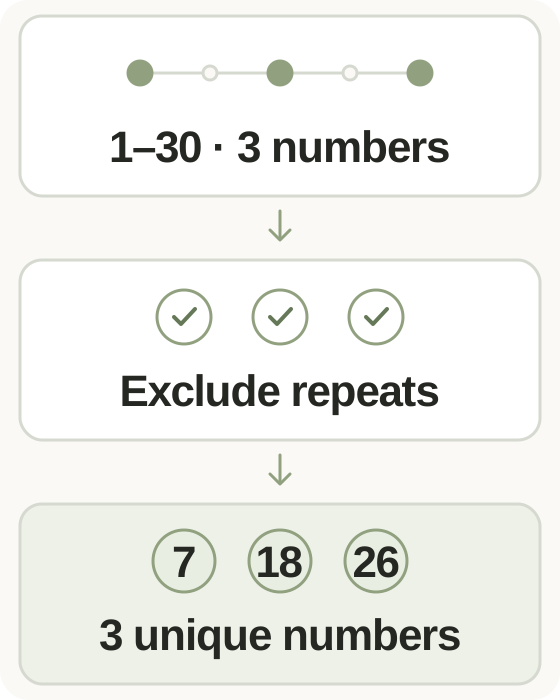
Step-by-step instructions and example screen
From input to result
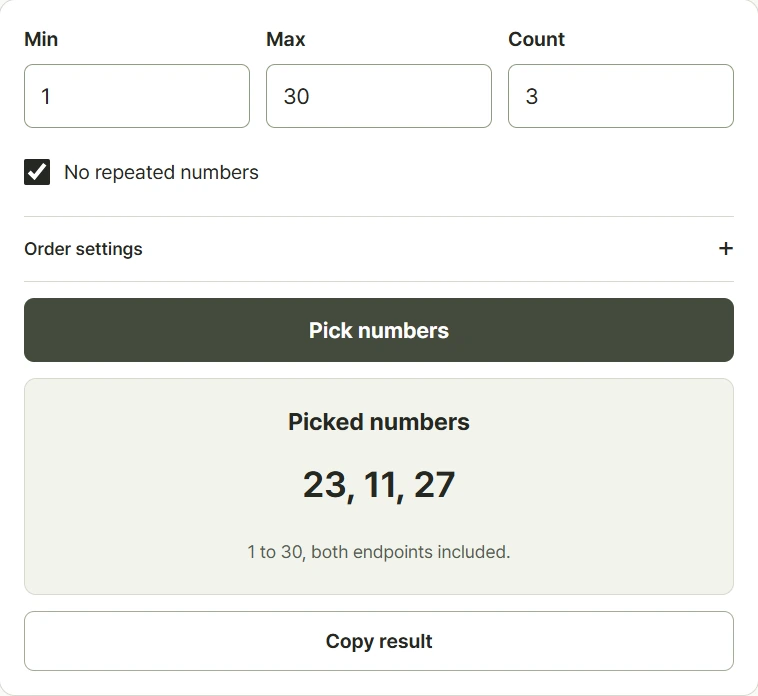
- Enter the minimum, maximum, and number of results.
- Choose whether numbers may repeat, and optionally sort them in ascending order.
- Run the draw and copy the results if you need to keep them.
When to use this tool
Choose presentation numbers
For a class numbered 1 through 30, draw three unique numbers to select three different presenters in the same round.
Allocate numbered seats
Draw six unique numbers from 1 to 24, then match them to your actual seat list before assigning places.
Repeat a game draw
Use a range of 1 to 6 and allow repeats when each result should be a separate pick from the same six possibilities.
Examples and calculation method
Worked examples
| Range | Settings | Result rule |
|---|---|---|
| 1 to 30 | 3 picks, unique | Three different participant numbers |
| 1 to 6 | 6 picks, unique, sorted | 1, 2, 3, 4, 5, 6 |
| -10 to 10 | 5 picks, repeats allowed | Five integers, including possible negatives |
Inclusive ranges and unique results
The generator uses random values from the browser's Web Crypto API. Values outside an evenly divisible portion of the random source are discarded before mapping to your range, avoiding modulo bias. Unique mode selects each integer at most once within the current draw. A new draw starts again with the full range. Supported endpoints are integers from -1,000,000,000 to 1,000,000,000, with a quantity from 1 to 100.
Understanding your result
- The minimum must not exceed the maximum; use whole numbers for both endpoints.
- Unique picks cannot outnumber the integers available in the chosen range.
- Sorting shows smaller values first; it does not make those values more likely to be drawn.
Frequently asked questions
Frequently asked questions
Are both ends of the range included?
Yes. A range of 1 to 6 can return any integer from 1 through 6, including both endpoints.
Why can a number appear again after another draw?
Unique mode applies within one draw. Running a new draw uses the full range again, so a previous result can return.
Can I request more unique numbers than the range contains?
No. A range of 1 to 6 contains six integers, so it cannot supply seven unique results. Expand the range or allow repeats.
Are my results saved?
Recent results remain in the open page only. They are not recorded in browser storage or on the server, and disappear when the page is reopened.